
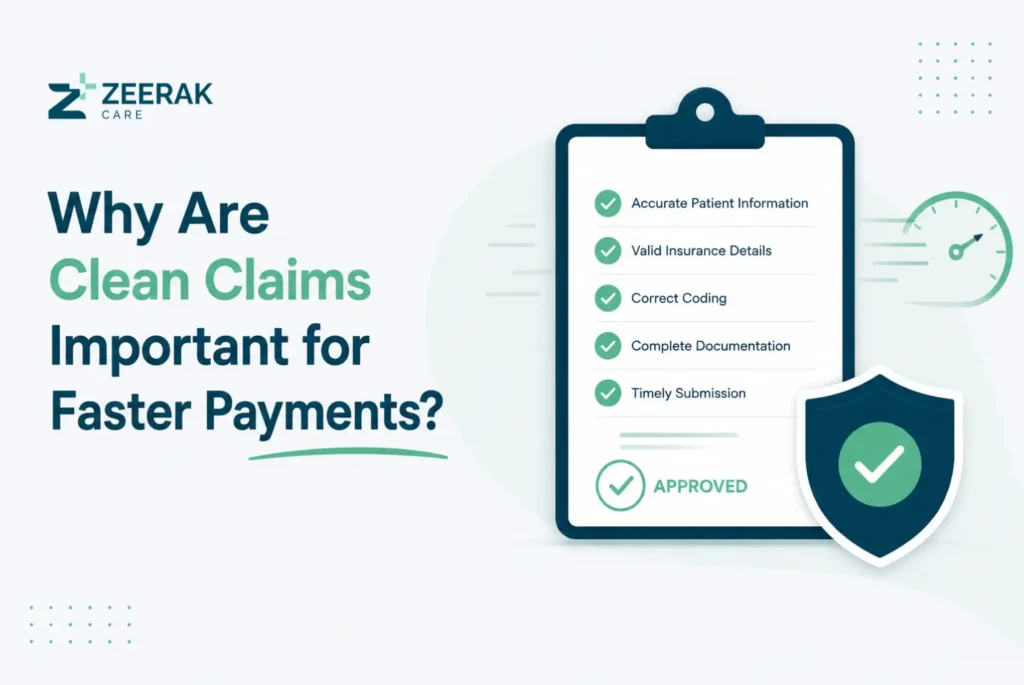
Clean claims are important for faster payments because they give insurance payers complete, accurate, and payer-compliant information needed to process a claim without avoidable corrections, rejections, or delays.
For healthcare providers, clean claims affect reimbursement speed, denial prevention, days in AR, payment posting, and revenue cycle management. A claim with incorrect patient data, missing authorization, coding errors, modifier issues, or payer-specific edit failures can delay payment and increase billing rework.
A clean claim in medical billing does not guarantee payment. It means the claim has enough accurate information to enter payer adjudication. The payer can still deny payment for coverage, medical necessity, benefit limits, or policy reasons.
For Medicare, CMS claims processing guidance states that clean claims must be paid or denied within 30 days of receipt. Interest may apply when payment is not made within that ceiling period.
What Is a Clean Claim in Medical Billing?
A clean claim in medical billing is a claim that contains the required patient, provider, coding, insurance, and service information needed for payer processing without avoidable defects.
A clean claim usually includes:
- Correct patient name and date of birth
- Valid insurance member ID and group number
- Correct provider NPI and tax ID
- Accurate CPT, ICD-10-CM, HCPCS, and modifier codes
- Correct place of service
- Valid prior authorization when required
- Correct payer and plan information
- Complete charge and service date details
- Documentation that supports medical necessity
The key point is simple. A clean claim is ready for payer review. A dirty claim is not.
Why Do Clean Claims Lead to Faster Reimbursement?
Clean claims lead to faster reimbursement because they reduce claim rejections, payer delays, manual review, denial risk, and AR follow-up workload.
| Clean Claim Area | Why It Matters |
| Patient data | Prevents demographic rejections |
| Eligibility verification | Reduces coverage-related denials |
| Accurate coding | Supports medical necessity |
| Correct modifiers | Prevents pricing and bundling errors |
| Valid authorization | Reduces authorization denials |
| Claim scrubbing | Catches errors before submission |
| Payer-specific edits | Improves payer acceptance |
| AR follow-up | Resolves unpaid claims faster |
Clean claims support faster payments because fewer claims need correction. Billing teams can spend less time fixing preventable errors and more time managing true payer issues.
Denials remain a major revenue concern. KFF reported that HealthCare.gov insurers denied an average of 19% of in-network claims in bronze plans in 2024, with denial rates varying by plan metal level.
Clean Claim vs Dirty Claim: What Is the Difference?
A clean claim can move through payer processing without avoidable correction, while a dirty claim contains missing, incorrect, or inconsistent information that delays reimbursement.
| Factor | Clean Claim | Dirty Claim |
| Data quality | Complete and accurate | Missing or incorrect |
| Coding | Supported by documentation | Incorrect or incomplete |
| Payer rules | Meets payer-specific edits | Fails payer or clearinghouse edits |
| Processing | Moves faster | Delayed or rejected |
| Revenue impact | Supports faster reimbursement | Increases AR and rework |
Dirty claims create administrative waste. Staff must identify errors, correct data, resubmit claims, and track delayed payer responses.
What Is Clean Claim Submission?
Clean claim submission is the process of sending a complete, accurate, and payer-ready claim through a billing system, clearinghouse, or payer portal.
Clean claim submission depends on the quality of the full billing workflow. Most claim errors begin before submission.
A strong clean claim process includes:
- Patient registration
- Eligibility verification
- Prior authorization check
- Provider documentation review
- Medical coding accuracy
- Charge entry validation
- Claim scrubbing
- Clearinghouse edits
- Payer-specific edits
- Claim status tracking
CMS describes electronic billing as structured data exchange between providers, Medicare, health plans, clearinghouses, and billing services.
How Does Eligibility Verification Improve Clean Claims?
Eligibility verification improves clean claims by confirming active insurance, benefits, patient responsibility, payer rules, and authorization requirements before the claim is created.
Eligibility verification checks:
- Active coverage
- Member ID
- Group number
- Copay
- Deductible
- Coinsurance
- Referral requirements
- Prior authorization
- Network status
- Primary and secondary insurance
A claim can be coded correctly and still fail if the patient’s insurance was inactive on the date of service. That is why clean claims start at patient intake, not only at claim submission.
How Does Medical Coding Accuracy Support Clean Claims?
Medical coding accuracy supports clean claims by matching provider documentation with the correct CPT, ICD-10-CM, HCPCS, and modifier codes.
Coding tells the payer what service was performed and why it was medically necessary. If the diagnosis does not support the procedure, the claim may be denied after payer adjudication.
Common coding-related clean claim errors include:
- Wrong CPT code
- Missing ICD-10-CM diagnosis code
- Unsupported medical necessity
- Missing modifier
- Incorrect modifier
- Wrong units
- Incorrect place of service
- Incomplete provider documentation
Medical coding accuracy protects reimbursement, compliance, and clean claim rate.
How Does Claim Scrubbing Prevent Payment Delays?
Claim scrubbing prevents payment delays by checking claims for missing data, coding issues, payer-specific edits, clearinghouse edits, and formatting errors before submission.
Claim scrubbing may happen inside billing software, a practice management system, or a clearinghouse.
Claim scrubbing checks:
- Patient demographics
- Insurance details
- Provider NPI
- Diagnosis and procedure code logic
- Modifier requirements
- Prior authorization fields
- Duplicate claims
- Timely filing risks
- Payer-specific edits
- Clearinghouse edits
This step improves healthcare claim accuracy and increases the clean claim rate because more claims pass the first submission check.
What Is the Difference Between Claim Rejection and Claim Denial?
A rejected claim fails before payer adjudication, while a denied claim is reviewed by the payer and refused for payment.
| Factor | Claim Rejection | Claim Denial |
| Timing | Before payer adjudication | After payer adjudication |
| Main cause | Missing data or invalid format | Coverage, coding, authorization, or medical necessity issue |
| Fix | Correct and resubmit | Appeal, correct, or submit documentation |
| Revenue risk | Payment delay | Possible revenue loss |
| Clean claim impact | Usually caused by preventable errors | May involve payer policy or documentation |
This difference matters because rejected claims usually need correction. Denied claims may need appeals, medical records, or payer-specific documentation.
What Role Do EDI 837 and EDI 835 Play in Clean Claims?
EDI 837 sends healthcare claims to payers, while EDI 835 returns payment, adjustment, denial, and remittance information to providers.
| Transaction | Purpose | Direction |
| EDI 837P | Professional claim submission | Provider to payer |
| EDI 837I | Institutional claim submission | Provider to payer |
| EDI 835 | Electronic remittance advice | Payer to provider |
EDI supports cleaner claim movement because it standardizes how billing data travels between providers, clearinghouses, and payers.
After Medicare processes a claim, CMS says either an Electronic Remittance Advice or Standard Paper Remittance is sent with final claim adjudication and payment information. The ERA or SPR reports adjustment reasons and adjustment values for claims or claim lines.
How Do Clean Claims Improve Payment Posting?
Clean claims improve payment posting by producing clearer payer responses, fewer correction cycles, and more accurate ERA, EOB, and adjustment data.
Payment posting records:
- Insurance payment
- Contractual adjustment
- Denial code
- Remark code
- Copay
- Deductible
- Coinsurance
- Patient balance
- Underpayment
- Secondary payer balance
When claims are inaccurate, payment posting becomes harder. The billing team may need to investigate missing payments, underpayments, duplicate adjustments, or unresolved denials.
Clean claims create cleaner remittance data. Cleaner remittance data helps the AR team act faster.
How Do Clean Claims Affect Clean Claim Rate?
Clean claims improve clean claim rate by increasing the percentage of claims accepted for processing without preventable errors on first submission.
Clean Claim Rate Formula
Clean Claim Rate = Clean Claims ÷ Total Claims Submitted × 100
Example:
If a practice submits 1,000 claims and 940 claims are accepted without preventable errors, the clean claim rate is:
940 ÷ 1,000 × 100 = 94%
A good clean claim rate depends on payer mix, specialty, claim volume, and billing complexity. Many practices aim for a rate above 90%, but the better goal is consistent improvement by payer, provider, location, and denial category.
First Pass Yield vs Clean Claim Rate: What Is the Difference?
Clean claim rate measures claim accuracy at submission, while first pass yield measures whether claims are paid on the first submission without rework.
| KPI | What It Measures | Why It Matters |
| Clean Claim Rate | Accuracy and completeness at submission | Finds front-end, coding, and scrubbing issues |
| First Pass Yield | Claims paid without rework | Shows billing effectiveness |
| Denial Rate | Claims refused after adjudication | Shows revenue leakage |
| Days in AR | Time claims remain unpaid | Shows payment speed |
A claim can be clean and still not be paid if the payer later denies it for medical necessity, coverage limits, or policy rules. That is why clean claim rate and first pass yield should be tracked together.
How Do Clean Claims Reduce Days in AR?
Clean claims reduce days in AR by helping claims move faster from submission to payer decision, payment posting, and final account resolution.
Days in AR measures how long claims remain unpaid. High days in AR often means delayed submission, claim errors, denial backlog, slow payment posting, or weak AR follow-up.
Clean claims reduce AR pressure because fewer claims need correction. The AR team can focus on true payer delays, underpayments, appeals, and aged balances.
Clean claims also improve revenue cycle management because the practice receives payment faster and has fewer accounts stuck in follow-up.
What Are the Most Common Clean Claim Errors?
The most common clean claim errors include incorrect demographics, inactive insurance, missing authorization, coding mistakes, missing modifiers, invalid NPI, and payer-specific edit failures.
| Error | Where It Happens | Reimbursement Impact |
| Wrong date of birth | Registration | Rejection |
| Inactive insurance | Eligibility verification | Denial or patient balance issue |
| Missing authorization | Pre-service review | Denial |
| Wrong CPT or ICD-10-CM code | Coding | Denial or underpayment |
| Missing modifier | Coding or charge entry | Reduced payment or denial |
| Invalid NPI | Claim setup | Rejection |
| Duplicate claim | Submission | Rejection or denial |
| Missed payer edit | Claim scrubbing | Delay or denial |
Most clean claim failures are preventable. The fix is usually stronger front-end verification, better coding review, and consistent claim scrubbing.
Practical Example: How Clean Claim Rate Affects Reimbursement
A clean claim rate example shows how small submission errors create major billing workload.
A primary care practice submits 1,000 claims in one month. If 940 claims pass payer and clearinghouse checks without preventable errors, the clean claim rate is 94%.
If the remaining 60 claims fail because of missing member IDs, inactive coverage, and modifier errors, the practice has 3 clear improvement areas:
- Improve front-desk insurance verification.
- Validate patient demographics before each visit.
- Review modifier use before claim submission.
This example shows why clean claims are not only a billing metric. They are a revenue performance signal.
How Can Healthcare Providers Improve Clean Claim Rates?
Healthcare providers improve clean claim rates by strengthening registration, eligibility verification, documentation, coding, claim scrubbing, payer edit management, and denial feedback loops.
Use this clean claim improvement checklist:
- Verify eligibility before every visit.
- Confirm prior authorization before service.
- Match patient demographics with payer records.
- Review documentation before coding.
- Use accurate CPT, ICD-10-CM, HCPCS, and modifiers.
- Apply payer-specific edits before submission.
- Use clearinghouse edits to catch format issues.
- Track claim rejection vs claim denial separately.
- Review denial trends every month.
- Monitor clean claim rate, first pass yield, days in AR, and denial rate.
This process improves claim quality and supports faster reimbursement.
When Should Providers Improve Their Claims Submission Process?
Providers should improve their claims submission process when clean claim rate drops, denials increase, days in AR rise, or billing staff spends too much time correcting preventable errors.
Warning signs include:
- Frequent demographic rejections
- High eligibility denial volume
- Missing authorization denials
- Slow payer adjudication
- Rising AR over 90 days
- Delayed payment posting
- Low first pass yield
- Repeated payer-specific edit failures
For practices that want fewer submission errors and faster payer processing, Zeerak Care’s Claims Submission Services can help improve claim accuracy, reduce preventable rework, and strengthen clean claim submission.
FAQs About Clean Claims
What are clean claims?
Clean claims are medical claims submitted with complete, accurate, and payer-compliant information required for processing without avoidable correction.
Why are clean claims important?
Clean claims are important because they reduce errors, rejections, denials, AR delays, and reimbursement delays.
Do clean claims always get paid?
Clean claims do not always get paid. They are ready for payer processing, but the payer can still deny payment for coverage, medical necessity, or policy reasons.
What is a good clean claim rate?
A good clean claim rate is usually above 90%, but the ideal target depends on specialty, payer mix, claim volume, and billing complexity.
What is the clean claim rate formula?
Clean Claim Rate = Clean Claims ÷ Total Claims Submitted × 100.
How do clean claims support faster payments?
Clean claims support faster payments by reducing correction work, payer rejections, denial risk, and AR follow-up.
Conclusion
Clean claims are important for faster payments because they help healthcare providers submit accurate, complete, and payer-ready claims that move through adjudication with fewer avoidable delays.
A strong clean claim process depends on eligibility verification, medical coding accuracy, claim scrubbing, payer-specific edits, clearinghouse edits, EDI 837 submission, EDI 835 remittance, accurate payment posting, and disciplined AR follow-up.
Clean claims improve reimbursement by reducing rejections, lowering denial risk, shortening days in AR, and improving revenue cycle management performance.
To reduce payment delays and improve claim accuracy, connect this article to Zeerak Care Claims Submission Services page as the next step for providers who need expert billing support.