Healthcare providers cannot receive reimbursement from most insurance companies until credentialing and payer enrollment are complete. Provider credentialing verifies a provider’s qualifications, while payer enrollment connects the provider with insurance networks for claim submission and payment processing. Both processes directly impact revenue, reimbursement timelines, and patient access to care.
For medical practices, hospitals, and healthcare groups, understanding how credentialing works with insurance payers helps prevent enrollment delays, claim denials, and revenue interruptions. Many providers rely on professional Provider Credentialing Services to manage documentation, applications, follow ups, and payer communications accurately and efficiently.
What Is Provider Credentialing?
Provider credentialing is the process insurance companies use to verify a healthcare provider’s education, training, licensure, certifications, work history, malpractice coverage, and professional standing before approving participation in their network.
Insurance payers conduct credentialing to ensure providers meet regulatory, legal, and quality standards required for patient care.
Credentialing typically applies to:
- Physicians
- Nurse Practitioners
- Physician Assistants
- Behavioral Health Providers
- Physical Therapists
- Occupational Therapists
- Chiropractors
- Specialty Care Providers
- Group Practices
Without credentialing approval, providers cannot participate in payer networks or receive reimbursement for covered services.
Why Do Insurance Payers Require Credentialing?
Insurance payers require credentialing to reduce risk, maintain compliance, and ensure quality healthcare delivery.
Before approving a provider, insurance companies verify:
- Active state licenses
- DEA registration
- Board certifications
- Educational background
- Residency and fellowship training
- Work history
- Malpractice insurance coverage
- Sanction and exclusion status
- National Provider Identifier (NPI)
- Professional references
This verification process protects patients, healthcare organizations, and insurance companies from fraud, compliance violations, and credentialing errors.
How Does Provider Credentialing Work With Insurance Payers?
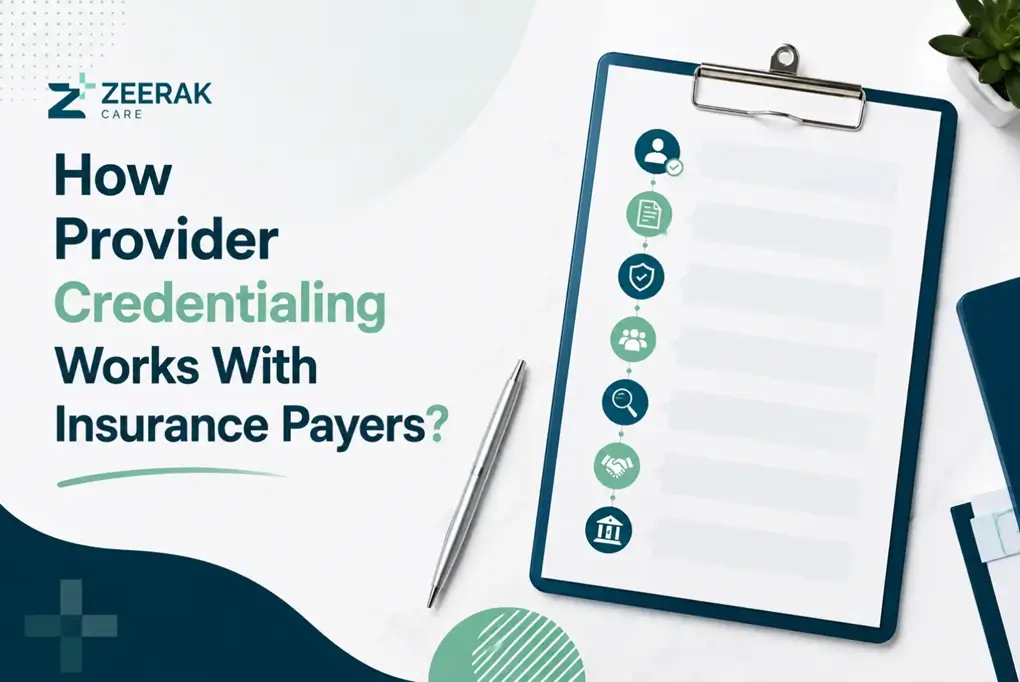
Provider credentialing follows a structured process involving document collection, verification, payer review, committee approval, and enrollment activation.
The complete process contains several stages.
Step 1: Gather Provider Information
The first step involves collecting all required provider documentation.
Common credentialing documents include:
- Medical license
- DEA certificate
- Board certifications
- Medical school diploma
- Residency certificates
- Curriculum vitae (CV)
- Malpractice insurance certificate
- NPI documentation
- CAQH profile information
- Professional references
Missing or outdated documents often delay approval timelines.
Step 2: Complete the CAQH Profile
The Council for Affordable Quality Healthcare (CAQH) serves as a centralized credentialing database used by many insurance companies.
Providers enter and maintain:
- Education history
- Licensure information
- Practice locations
- Specialty information
- Professional liability coverage
- Work history
Many payers access credentialing information directly through CAQH, making profile accuracy essential.
Step 3: Submit Applications to Insurance Payers
After documentation is verified, applications are submitted to selected insurance carriers.
Examples include:
- Aetna
- Cigna
- UnitedHealthcare
- Humana
- Blue Cross Blue Shield
- Medicare
- Medicaid
Each payer maintains unique enrollment requirements, forms, and processing procedures.
Accurate submission reduces application rejections and resubmission requests.
Step 4: Primary Source Verification
Insurance companies perform primary source verification before approving providers.
This process confirms information directly with issuing organizations.
Payers verify:
- State licensing boards
- Medical schools
- Residency programs
- Certification boards
- DEA databases
- Malpractice carriers
Primary source verification represents one of the longest stages of credentialing.
Step 5: Payer Review and Committee Evaluation
After verification is complete, the application moves through internal payer review.
Credentialing committees evaluate:
- Provider qualifications
- Compliance history
- Practice eligibility
- Professional conduct
- Risk assessments
Additional information may be requested if discrepancies are identified.
Step 6: Network Approval
Once approved, the provider receives network participation confirmation.
The payer assigns:
- Effective participation date
- Provider network status
- Reimbursement schedules
- Contract information
Providers can begin treating in network patients according to payer requirements.
Step 7: Payer Enrollment Activation
Credentialing approval does not always mean claims can immediately be submitted.
Enrollment activation ensures the provider appears in the payer’s claims processing and reimbursement system.
This stage often requires specialized Payer Enrollment Services to manage enrollment tracking, contract updates, and payer communications.
Once activation is complete, providers can submit claims and receive reimbursement.
How Long Does Provider Credentialing Take?
Provider credentialing timelines vary by payer, specialty, and state.
The following table outlines common processing timeframes.
| Credentialing Stage | Typical Timeline |
| Document Collection | 1 to 2 Weeks |
| CAQH Setup and Verification | 1 to 2 Weeks |
| Application Submission | 3 to 7 Days |
| Primary Source Verification | 30 to 60 Days |
| Payer Committee Review | 15 to 30 Days |
| Network Approval | 1 to 2 Weeks |
| Enrollment Activation | 2 to 4 Weeks |
Most providers experience total credentialing timelines between 60 and 120 days.
Government payers and certain commercial insurers may require longer processing periods.
What Factors Delay Provider Credentialing?
Credentialing delays often occur because of incomplete applications or inaccurate information.
Common causes include:
Incomplete Documentation
Missing licenses, expired certificates, and incomplete work history records frequently delay approvals.
CAQH Errors
Outdated CAQH profiles create verification issues for insurance carriers.
License Verification Issues
Inactive or expired licenses require additional review and correction.
Malpractice Coverage Gaps
Missing professional liability insurance documentation may suspend credentialing reviews.
Slow Payer Processing
Some insurance companies experience significant credentialing backlogs during high volume periods.
Practice Ownership Changes
New practice locations, mergers, and acquisitions often require additional enrollment verification.
How Does Credentialing Impact Revenue Cycle Performance?
Provider credentialing directly affects financial performance because reimbursement cannot begin until enrollment becomes active.
Delayed credentialing commonly results in:
- Delayed payments
- Lost revenue opportunities
- Claim denials
- Increased accounts receivable
- Patient scheduling restrictions
Healthcare organizations often integrate credentialing with broader Revenue Cycle Management Services to maintain uninterrupted reimbursement workflows.
When credentialing, enrollment, billing, and collections operate together, practices experience fewer payment disruptions and improved cash flow.
What Is the Difference Between Credentialing and Payer Enrollment?
Credentialing and payer enrollment are related but different processes.
| Provider Credentialing | Payer Enrollment |
| Verifies provider qualifications | Activates billing participation |
| Focuses on compliance and eligibility | Focuses on reimbursement setup |
| Reviews education and licensure | Establishes payer contracts |
| Determines network eligibility | Enables claim submission |
| Conducted before enrollment approval | Conducted after credentialing review |
Both steps are required before a provider can receive insurance reimbursement.
Why Do Healthcare Organizations Outsource Credentialing?
Many healthcare organizations outsource credentialing because the process requires extensive documentation, payer communication, compliance tracking, and follow up management.
Outsourcing helps practices:
- Reduce administrative workload
- Accelerate approvals
- Prevent enrollment delays
- Improve compliance accuracy
- Increase reimbursement readiness
- Support multi provider growth
Organizations that combine credentialing with professional Medical Billing Services often achieve smoother claim processing and faster reimbursement cycles because provider records remain accurate across billing and payer systems.
How Can Providers Maintain Credentialing Compliance?
Credentialing does not end after approval.
Providers must continuously maintain:
- Active licenses
- Board certifications
- DEA registrations
- Malpractice insurance
- CAQH attestations
- Payer contract updates
Most insurance companies require periodic recredentialing every two to three years.
Ongoing monitoring prevents participation interruptions and reimbursement delays.
Frequently Asked Questions
How long does provider credentialing take with insurance payers?
Provider credentialing typically takes 60 to 120 days. Processing time depends on payer requirements, provider specialty, document accuracy, and verification timelines.
What is the difference between provider credentialing and payer enrollment?
Provider credentialing verifies qualifications and compliance, while payer enrollment activates a provider within an insurance network for claim submission and reimbursement.
Can providers bill insurance before credentialing is complete?
No. Most insurance companies require completed credentialing and active payer enrollment before reimbursing claims for covered services.
Why do credentialing applications get delayed?
Credentialing delays commonly result from incomplete documentation, expired licenses, CAQH errors, missing malpractice information, and payer processing backlogs.
How often do providers need recredentialing?
Most insurance payers require recredentialing every two to three years to verify licenses, certifications, professional standing, and compliance status.
Conclusion
Provider credentialing is a foundational process that allows healthcare providers to participate in insurance networks and receive reimbursement for services delivered. The process involves document collection, CAQH management, payer application submission, primary source verification, committee review, network approval, and enrollment activation.
Most credentialing projects require 60 to 120 days, depending on payer requirements and application accuracy. Delays often result from incomplete documentation, outdated provider information, and payer processing backlogs.
A structured credentialing strategy supported by payer enrollment, revenue cycle management, and billing operations helps healthcare organizations reduce delays, maintain compliance, and establish a stronger financial foundation for long term growth.